
Infrared Sauna Heater Comparison: Carbon vs Ceramic vs Halogen vs VantaWave® (2026)
Key Takeaways
- There are only three types of infrared heaters: carbon, ceramic, and halogen. Marketing terms like "full spectrum" and "tri-light fusion" are repackaged versions of these three
- Heater surface temperature determines wavelength output via Wien's Law — the calculated peak wavelength changes with surface temperature
- Heater material alone does not determine performance. Compare measured temperature, radiant coverage, placement, controls, guarding, and complete-system documentation.
- Magnetic-field readings are comparable only when frequency, distance, position, load, meter, average, and maximum are disclosed. The published VantaWave average is <0.20 mG at the seated position.
- Emissivity describes surface radiance relative to an ideal blackbody at the same temperature; it is not electrical conversion efficiency and should be evaluated with temperature and coverage.
Your heaters are the heart of your infrared sauna — every claimed health benefit depends entirely on heater quality. And this is where most companies cut corners, because most buyers don't understand the physics well enough to know the difference.
I'm Chris, and at SaunaCloud we design and manufacture our own infrared heaters, power supplies, and control electronics in-house. No other residential sauna company in North America does this. This page is the technical breakdown I wish existed when I started this business in 2014 — the engineering behind what makes one heater therapeutic and another one expensive air warming.
There are only three types of infrared heaters used in saunas today: carbon, ceramic, and halogen. Everything else — 'full spectrum,' 'tri-light fusion,' 'dual-wave technology' — is marketing language for one of these three. Let me show you how each works, where each fails, and what we engineered to fix the problems with all of them.
Wien's Law: the physics that governs every heater
Before comparing specific heater types, you need to understand one principle: Wien's Law of Displacement. It states that every heated object emits infrared radiation at a peak wavelength determined by its temperature. Hotter objects emit shorter wavelengths. Cooler objects emit longer wavelengths.
The formula: Peak wavelength (microns) = 5268 / (surface temperature °F + 460)
Water-rich tissue strongly absorbs infrared across this region, but wavelength alone does not determine treatment depth or dose. Radiant intensity, distance, exposure time, coverage, and surface temperature all matter when evaluating a heater system.
This single principle explains why heater surface temperature matters so much — it's not about 'hotter is better.' It's about which temperature produces the wavelength your body absorbs most effectively.
| Example | Surface temperature | Calculated Wien peak |
|---|---|---|
| Lower-temperature panel | 140–150°F | Approximately 8.6–8.7μm |
| VantaWave® panel | Up to 190°F | Approximately 8.0μm |
| Higher-temperature ceramic example | 390°F | Approximately 6.1μm |
| Halogen example | 750°F | Approximately 4.3μm |
Wien's law identifies the peak of a broad thermal emission curve. It does not by itself establish treatment depth, dose, or health benefit.
Carbon panel heaters: the budget standard
Carbon panels dominate the mass-market sauna industry because they're cheap to manufacture. They're thin, lightweight, cover large surface areas, and produce relatively low EMF. At first glance, they seem ideal.
Many carbon panels operate around 140–150°F. Wien's Law gives a calculated peak near 8.6–8.7 microns at those temperatures. Their total radiant output still depends on temperature, emissivity, surface area, distance, and power; the material label alone does not tell you how effectively the complete sauna heats its user.
Think of it this way: a campfire from 20 feet away is technically radiating infrared at you. But you're not getting a therapeutic dose. A carbon panel at 140°F is the sauna equivalent — technically infrared, practically insufficient for raising core body temperature efficiently.
Carbon panels have their place in budget saunas ($1,500-$3,000). But if you're investing $5,000+ in a therapeutic infrared sauna, you need more radiant output than standard carbon can deliver.
Ceramic heaters: powerful but problematic
Ceramic surfaces can have high emissivity — radiating effectively relative to an ideal blackbody at the same temperature. Emissivity does not by itself measure electrical-to-infrared conversion efficiency, and heater performance still depends on temperature, geometry, power delivery, placement, and controls.
Ceramic heaters operate at 350-400°F, producing peak emission around 6-7 microns. This is closer to the therapeutic sweet spot than carbon, and the high emissivity means strong radiant output.
The problems are practical. At 350-400°F, ceramic heaters are uncomfortably hot at close range — you can feel the burn if you're sitting 6-12 inches away, which is the typical distance in a sauna. They create intense 'hot spots' directly in front of the element while areas between elements receive much less infrared. They're small and focused rather than broad and even. And some ceramic designs produce higher EMF due to the wiring configuration needed to reach those temperatures.
Ceramic heaters were the standard in early infrared saunas (1990s-2000s). They work, but the user experience is harsh — short sessions because of the intensity, uneven heating, and limited surface coverage.
Halogen heaters: the 'full spectrum' marketing play
Halogen heaters are quartz tube elements that operate at high temperatures. At approximately 750°F, Wien's Law gives a calculated peak around 4.4 microns, generally classified as mid-infrared rather than the 0.75–1.4 micron near-infrared band commonly used for LED photobiomodulation.
This is where the 'full spectrum' marketing comes from. Companies like Clearlight and others use halogen elements alongside carbon panels and claim to deliver near, mid, and far infrared. The implication is that more wavelengths = more therapeutic benefit.
The reality is more nuanced. Near infrared at 4.4 microns from a halogen bulb doesn't penetrate tissue the same way as near infrared LEDs at 850nm. They're in completely different parts of the infrared spectrum despite both being called 'near infrared.' Therapeutic near-infrared applications (skin health, wound healing, mitochondrial stimulation) use LEDs at 660-850nm delivered within inches of the skin — not halogen bulbs mounted on a wall 2-3 feet away.
Halogen elements do add significant heat to a sauna room. But they add it as intense, concentrated radiant heat that feels harsh. Our overhead halogen element in the Atlas system reaches approximately 750°F and is positioned on the ceiling to provide supplemental heat from above — but the primary therapeutic delivery comes from the VantaWave® far infrared panels at 7.9 microns.
VantaWave®: engineered to solve all three problems
We created VantaWave® to combine broad heater coverage, controlled surface temperature, low full-system magnetic-field readings, and matched power and controls in one engineered system.
VantaWave® panels operate up to 190°F. At that temperature, Wien's Law gives a calculated blackbody peak of approximately 8.0 microns within a broad thermal emission curve.
The emissivity is 0.97 — not quite ceramic's 0.99, but dramatically higher than standard carbon's 0.94-0.95. Combined with the higher surface temperature, this means significantly more total therapeutic infrared output per square inch than any carbon panel.
Coverage is broad and even — the panel design distributes heat across a large surface area rather than concentrating it in a small element. And EMF averages less than 0.20 mG at the seated position. We publish these numbers. We invite testing.
The CORE 5™ power supply is the other half of the equation. We engineered our own power delivery system to feed VantaWave® panels precisely the power they need for optimal temperature regulation. This is why we can maintain the 190°F+ surface temperature consistently across the entire panel — something that requires tight electronic control, not just a thermostat.
| What to compare | Carbon panels | Ceramic elements | Halogen elements | VantaWave® system |
|---|---|---|---|---|
| Typical heat pattern | Broad, lower-temperature panels | Concentrated high-temperature elements | Intense directional heat | Broad panels in a room-specific layout |
| Surface temperature | Varies by panel and power | Varies by element and guarding | Varies by element and controls | Up to 190°F |
| Peak wavelength | Temperature-dependent | Temperature-dependent | Temperature-dependent | Calculated near 8μm at operating temperature |
| EMF evidence to request | A complete-system test at the user position, under full load, with distance and frequency stated | Published average <0.20 mG at the seated position | ||
| System scope | Confirm whether power, thermostat, controller, frames, guarding, and plans are included | Matched heaters, CORE 5 power and controls, thermostat, frames, plans, and support | ||
EMF: the hidden variable in heater quality
EMF — electromagnetic fields — deserves its own section because it's the most misunderstood and most variable specification in the entire infrared sauna industry.
Every electrical device produces EMF. The question for sauna buyers is: how much, and does it matter? In an infrared sauna, you sit 6-12 inches from heaters for 30-40 minutes, 4-7 times per week, for years. That's a unique exposure pattern that most EMF research doesn't specifically address.
The variation between brands is staggering. Cheap imported carbon heaters can produce 20-100 mG at the seated position. Some ceramic configurations produce even more due to wiring density. There is no universal WHO 3 mG exposure limit for sauna use.
| Test detail | What the manufacturer should disclose | Published VantaWave® condition |
|---|---|---|
| Position | Distance and actual user location | Seated position |
| Operating state | Panel-only or complete system; idle or full load | Complete system operating |
| Result | Average and maximum, with meter and frequency range | Average <0.20 mG |
No health-based safe limit is asserted here. Compare measurements taken under equivalent conditions.
VantaWave® achieves <0.20 mG through deliberate engineering — the wiring path, conductor geometry, shielding, and power delivery are all designed to cancel electromagnetic fields. This isn't a side benefit; it's a primary design requirement. When you're building saunas intended for daily therapeutic use over decades, EMF minimization is non-negotiable.
The test for any sauna company: ask for EMF testing results measured at the seated position with heaters at full power. Not at the wall. Not with heaters warming up. At the position where you actually sit, with everything running at maximum. If they can't provide this, or won't, that tells you everything.
Why placement matters as much as heater type
Even the best heater underperforms if it's poorly positioned. Infrared energy follows the inverse square law — intensity drops dramatically with distance. A heater 6 inches from your back delivers roughly 4x the therapeutic infrared as the same heater 12 inches away.
Most mass-produced saunas mount heaters on 1-2 walls. You end up with intense infrared on one side and almost none on the other. Your back gets treatment while your chest doesn't.
Our Atlas™ custom infrared sauna heater placement system positions VantaWave® panels on all surfaces surrounding the user — behind the back, beside the legs, overhead, and in front. This ensures consistent therapeutic delivery to your entire body from all directions. The specific placement angles and distances are calculated for each custom installation based on the sauna's dimensions. For the complete science of how infrared saunas work — from photon emission to health effect — see our pillar guide.
Seven questions to ask any infrared heater supplier
- What is the measured surface-temperature range? Ask for normal operating conditions, not only a maximum.
- Is the wavelength measured or calculated? A Wien-law peak is useful context but is not a spectral test report.
- How was emissivity measured? Request the method and spectral range rather than treating emissivity as electrical efficiency.
- Was the complete system tested for EMF? Require the user position, distance, load, frequency range, meter, average, and maximum.
- Which safety controls are included? Confirm the thermostat, independent over-temperature protection, controller, disconnects, frames, and guarding.
- What arrives with the system? Clarify power supplies, wiring, mounting hardware, plans, and installation support before comparing prices.
- What does the warranty actually cover? Separate heater coverage from power supplies, controls, labor, commercial use, and installation exclusions.
Replacing or retrofitting heaters in an existing sauna
Do not treat a replacement heater as a like-for-like appliance swap. Panel dimensions, wattage, supply voltage, branch-circuit capacity, thermostat and over-temperature controls, clearances, guarding, wiring, ventilation, and the enclosure condition all have to be reviewed as one system.
If an existing infrared sauna has a failed panel or uneven heating, start with our infrared sauna repair and troubleshooting guide. For a sound traditional sauna enclosure, see the traditional-to-infrared conversion guide. SaunaCloud can quote a complete VantaWave heater system for eligible new builds, conversions, and upgrades after reviewing the room.
A complete retrofit review should cover
- Room dimensions, construction, condition, and ventilation
- Existing voltage, circuit capacity, disconnects, and grounding
- Heater coverage, frames, guarding, and required clearances
- Matched thermostat, over-temperature protection, controller, and power supply
- Installation by qualified trades under applicable local codes
Frequently Asked Questions
What are the three types of infrared sauna heaters?
Carbon panels, ceramic elements, and halogen bulbs. Marketing terms like 'full spectrum,' 'tri-light fusion,' and 'dual-wave' are repackaged names for combinations of these three technologies.
Which heater type is best for raising core body temperature?
No material wins on its name alone. Compare measured surface temperature, radiant coverage, distance from the user, power and temperature controls, guarding, complete-system testing, and whether the manufacturer can document the installation requirements. Those system variables determine delivered heat and usability.
What does emissivity mean for infrared saunas?
Emissivity measures how effectively a surface radiates compared with an ideal blackbody at the same temperature, on a scale up to 1.0. It is not the same as electrical conversion efficiency. Compare emissivity alongside surface temperature, coverage, controls, and complete-system performance.
Are halogen heaters really 'full spectrum'?
A hot halogen element emits a broad spectrum, but a calculated 4.4-micron peak is generally mid-infrared, not the 660–850 nm visible-red and near-infrared range used in LED photobiomodulation research. Evaluate the actual spectral output, distance, irradiance, and intended use rather than relying on the phrase 'full spectrum.'
What's a safe EMF level for an infrared sauna?
There is no universal WHO 3 mG limit for sauna use, and this page does not assert a health-based safe threshold. Ask for complete-system measurements at the user position with the heaters at full power, including the distance, frequency range, meter, and whether the result is an average or maximum. The published VantaWave average is <0.20 mG at the seated position.
Why can't I just buy a cheap carbon sauna and get the same benefits?
A lower-cost carbon sauna may still provide useful heat, but product quality varies. Compare the complete system: measured heater temperature, panel area and placement, power and controls, electrical safety documentation, full-load magnetic-field testing, construction materials, warranty, and service support.
Carbon vs ceramic heaters: what are the pros and cons?
Carbon panels cover large areas and feel comfortable near the body, but many operate at lower surface temperatures with lower total radiant output. Ceramic elements run hotter with strong output per square inch, but feel harsh up close and heat unevenly. Compare measured surface temperature, radiant coverage, distance from the user, power and temperature controls, guarding, and complete-system test documentation rather than choosing on the material name alone.

Founder & Lead Designer, SaunaCloud®
3,000+ custom saunas built since 2014 · Author of The Definitive Guide to Infrared Saunas · Featured in Forbes, Inc., and MSN
Chris has been designing and building custom infrared saunas since 2014. He wrote one of the first comprehensive books on infrared sauna therapy and is personally involved in every SaunaCloud build — from design consultation through delivery and beyond. His professional expertise is sauna design and construction, not clinical medicine.
Continue Reading

How Infrared Saunas Work: From Photon to Health Effect in Five Steps (2026)
Read article
The Infrared Sauna Buying Guide: 10 Things to Know Before You Buy (2026)
Read article
Are Infrared Saunas Safe? The Evidence-Based Answer (2026)
Read article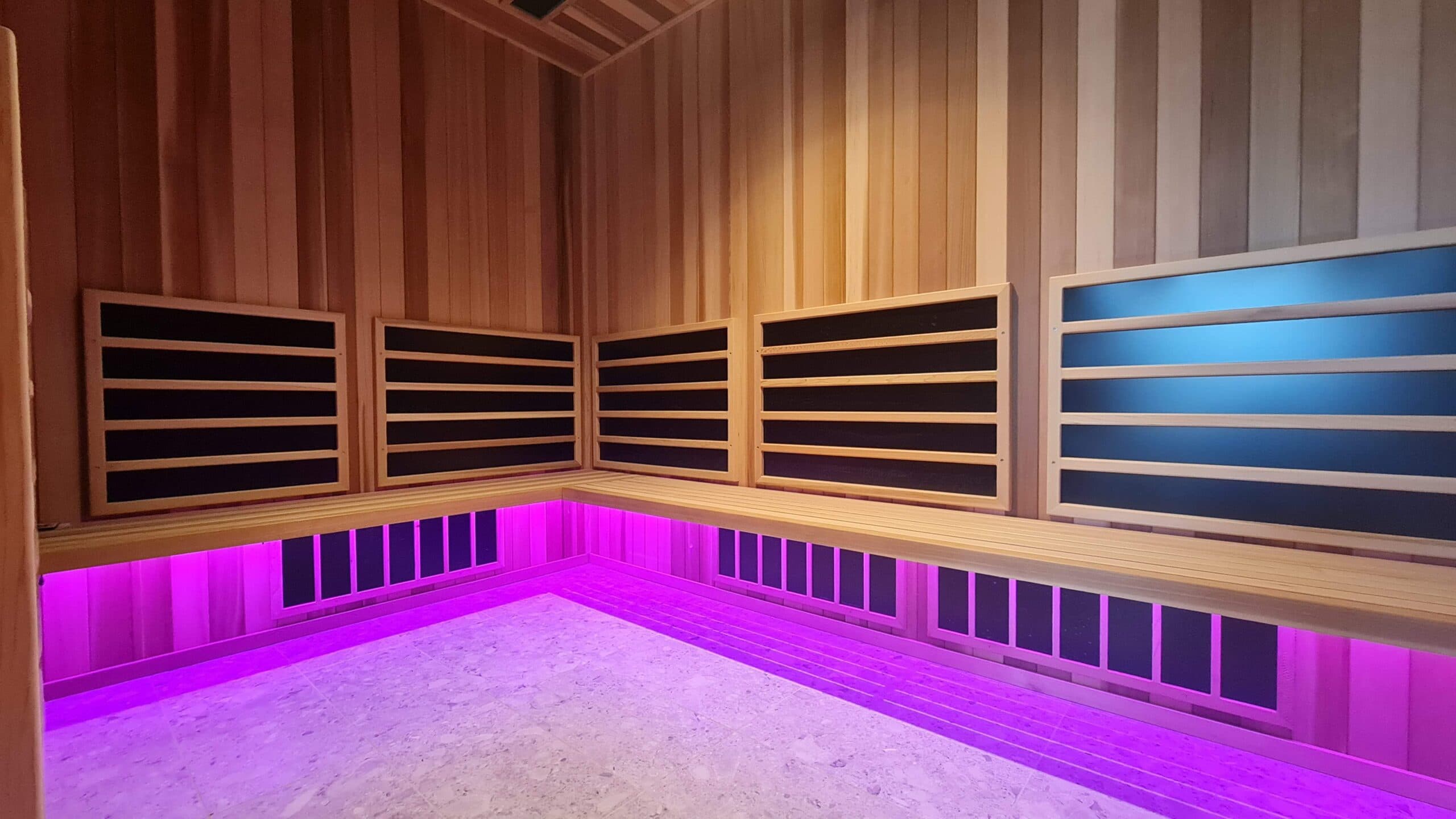
Ready for a Complete Heater System?
Tell us about your room. SaunaCloud will evaluate heater coverage, CORE 5 controls, electrical requirements, and placement before preparing a system quote.